
Rules and ethics
Part of What are the shopping feed rules and ethics in the UK?
What the shopping feeds advertising rules mean for smaller retailers
Shopping feeds rules for UK retailers: check CAP Code claims, CMA consumer law, platform listing policies, product data and customer data.
What to take away
- The CMA gained direct enforcement powers over unfair commercial practices in April 2025 under the Digital Markets, Competition and Consumers Act 2024, so a misleading feed can now bring a regulator's own penalty.
- A product feed is treated as advertising copy, so any claim it carries can be judged against the CAP Code.
- The ASA can act once a UK consumer sees the ad, whether that appears on a search engine, a marketplace or a social platform.
- Feed data passes between you, an agency, a feed tool and a retail partner, which brings UK GDPR data-sharing duties into the same workflow.
- Wrong prices, missing stock and unclear delivery costs are the fields most likely to trigger a complaint.
Why feed rules became an advertising question
The CAP Code applies to non-broadcast ads, including feed-driven ads. Rules 3.1 and 3.3 prohibit misleading advertising and material omissions; rules 3.17–3.20 cover price statements and additional charges. CAP writes the codes, and the ASA administers them and rules on complaints.
A single feed field can breach a rule. A price that omits a mandatory fee, a size range that overstates stock, or a delivery estimate the customer never receives can all mislead. The test is how the average consumer reads the ad, not what your spreadsheet intended.
Consumer protection law runs alongside the advertising codes. The Consumer Rights Act 2015 covers the standards goods must meet and the remedies available to consumers. For distance sales, the Consumer Contracts (Information, Cancellation and Additional Charges) Regulations 2013 set information and cancellation requirements, while the Price Marking Order 2004 governs price indications.
Direct CMA enforcement matters because a feed error can now attract a fine decided by the regulator, not a referral to Trading Standards. Our UK rules and compliance guide for 2027 shows how the advertising, consumer and data rules fit together across channels.
A working checklist for feed advertisers
Work through this list before a campaign goes live, then repeat it mid-flight.
Before you publish
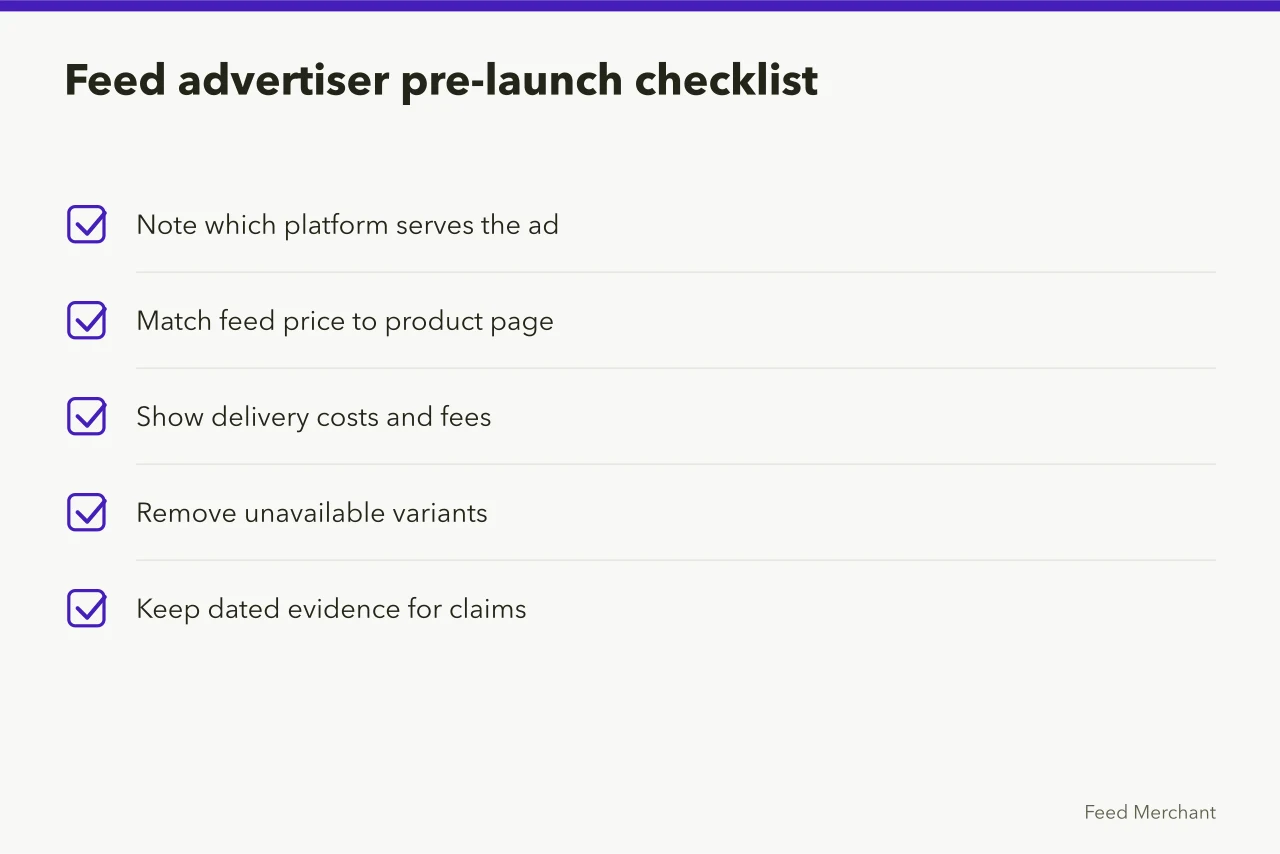
- Check that each advertised price matches the product page and checkout. Include mandatory charges in the price; do not use drip pricing that reveals them only at checkout.
- Match the product title, product identifiers (such as a GTIN where applicable), variant or size, condition, availability, sale price, shipping charge and landing-page URL to the product page and checkout. Keep evidence for objective claims and any “was” price.
- Do not use a countdown timer that resets or create false low-stock urgency.
- Google Merchant Center's Misrepresentation policy prohibits misleading business or product information, unavailable offers and omissions of material details, such as total price or delivery terms. Meta Commerce Policies prohibit listings for items including weapons, tobacco and illicit drugs; its commerce eligibility requirements also apply. Make sure each listing accurately represents the item, image and price.
- If you also send catalogues or product listings to Amazon, Microsoft Merchant Center, TikTok or Pinterest, check the rules for the specific service and destination before export; product-listing and catalogue-ad requirements vary.
While campaigns run
Checks while campaigns run
- Compare feed snapshot with live page daily
- Log each price, claim or stock change
- Name one person to pause feeds
- Feed customer questions back to copywriter
- Reconcile feed prices, availability and shipping charges with product pages and checkout on a regular schedule.
- Check that delivery promises, landing-page links and product variants remain accurate while campaigns run.
- Use alerts or exception reports in your feed tool where available, and agree with an agency who will investigate and correct each issue. Keep a short record of changes and checks.
- Pause or correct ads promptly when a price, stock level, claim or landing page becomes inaccurate. Recheck the relevant platform policies after material feed or campaign changes.
Where data protection meets feed advertising rules
Feeds often carry customer segments, order values or email audiences to a platform or a retail partner. The ICO's data sharing guidance covers lawful bases, transparency and the records you should keep.
For each personal data field, identify its purpose and lawful basis, tell people how it will be used, and set a retention period. Apply data minimisation and protect the data; check whether you and the platform or partner are acting as controller or processor, and document the sharing arrangement.
For a feed or audience upload, review fields such as email addresses, phone numbers, customer segments and order values when linked to an identifiable person. Include only fields needed for the stated purpose, and check that the privacy information and sharing arrangements cover their use.
Comparison: who checks what in a feed
The table below shows which body covers which part of a feed campaign.
Who checks what in a feed
Remit
- ASA and CAP
- Advertising codes for non-broadcast ads
- CMA
- Consumer protection and unfair commercial practices
- ICO
- UK GDPR and data sharing
- Trading Standards
- Local enforcement of consumer law in England
Effect on feeds
- ASA and CAP
- Claims, prices and images in feed-driven ads
- CMA
- Drip pricing, false urgency and misleading availability
- ICO
- Customer lists and segments sent to platforms
- Trading Standards
- Complaints raised in your area
Common questions
Do advertising rules apply to a feed sent to a marketplace?
Yes. Even when the marketplace builds the ad, the claims and prices in your feed fall under the CAP Code. Platform terms do not replace the law.
Who is responsible, the retailer or the feed tool?
The advertiser is. Responsibility sits with the business named in the ad and with any agency acting for it. A feed tool is a supplier.
Does this differ in Scotland, Wales or Northern Ireland?
Consumer protection law is UK-wide, but court procedures and local enforcement differ. The ASA covers the whole UK, while Trading Standards works through local authorities.
Do I need a specialist adviser before publishing?
Not for routine fields, but take advice from a qualified adviser on pricing structures, green claims and personal data, since each case turns on its facts.